Electronics, Power Electronics, Optoelectronics, Microwaves, Electromagnetics, and Radar


Richard C. Dorf, "Electronics, Power Electronics, Optoelectronics, Microwaves, Electromagnetics, and Radar (Electrical Engineering Handbook)"
CRC | 2006-01-13 | ISBN: 0849373395 | 888 pages | PDF | 13.7 MB

In two editions spanning more than a decade, The Electrical Engineering Handbook stands as the definitive reference to the multidisciplinary field of electrical engineering. Our knowledge continues to grow, and so does the Handbook. For the third edition, it has expanded into a set of six books carefully focused on a specialized area or field of study. Electronics, Power Electronics, Optoelectronics, Microwaves, Electromagnetics, and Radar represents a concise yet definitive collection of key concepts, models, and equations in these areas, thoughtfully gathered for convenient access.
ادامه نوشته

An Introduction to Radio Frequency Engineering

                     An Introduction to Radio Frequency Engineering


                                                      دانلود

                                     پسورد:www.iiets.blogfa.com

Data Acquisition for Instrumentation and Control System


                                                 دانلود

                                 پسورد:www.iiets.blogfa.com

Robotic & Control

e-book رباتیک و چگونگی کنترل رباتیک 


                                                  دانلود

                                 پسورد:www.iiets.blogfa.com


[2] FUZZY CONTROL IN DETAIL

 FUZZY CONTROL IN DETAIL

* Fuzzy controllers are very simple conceptually. They consist of an input stage, a processing stage, and an output stage. The input stage maps sensor or other inputs, such as switches, thumbwheels, and so on, to the appropriate membership functions and truth values. The processing stage invokes each appropriate rule and generates a result for each, then combines the results of the rules. Finally, the output stage converts the combined result back into a specific control output value.

The most common shape of membership functions is triangular, although trapezoids and bell curves are also used, but the shape is generally less important than the number of curves and their placement. From three to seven curves are generally appropriate to cover the required range of an input value, or the "universe of discourse" in fuzzy jargon.

As discussed earlier, the processing stage is based on a collection of logic rules in the form of IF-THEN statements, where the IF part is called the "antecedent" and the THEN part is called the "consequent". Typical fuzzy control systems have dozens of rules.

Consider a rule for a thermostat:

   IF (temperature is "cold") THEN (heater is "high")

This rule uses the truth value of the "temperature" input, which is some truth value of "cold", to generate a result in the fuzzy set for the "heater" output, which is some value of "high". This result is used with the results of other rules to finally generate the crisp composite output. Obviously, the greater the truth value of "cold", the higher the truth value of "high", though this does not necessarily mean that the output itself will be set to "high", since this is only one rule among many.

In some cases, the membership functions can be modified by "hedges" that are equivalent to adjectives. Common hedges include "about", "near", "close to", "approximately", "very", "slightly", "too", "extremely", and "somewhat". These operations may have precise definitions, though the definitions can vary considerably between different implementations. "Very", for one example, squares membership functions; since the membership values are always less than 1, this narrows the membership function. "Extremely" cubes the values to give greater narrowing, while "somewhat" broadens the function by taking the square root.

In practice, the fuzzy rule sets usually have several antecedents that are combined using fuzzy operators, such as AND, OR, and NOT, though again the definitions tend to vary: AND, in one popular definition, simply uses the minimum weight of all the antecedents, while OR uses the maximum value. There is also a NOT operator that subtracts a membership function from 1 to give the "complementary" function.

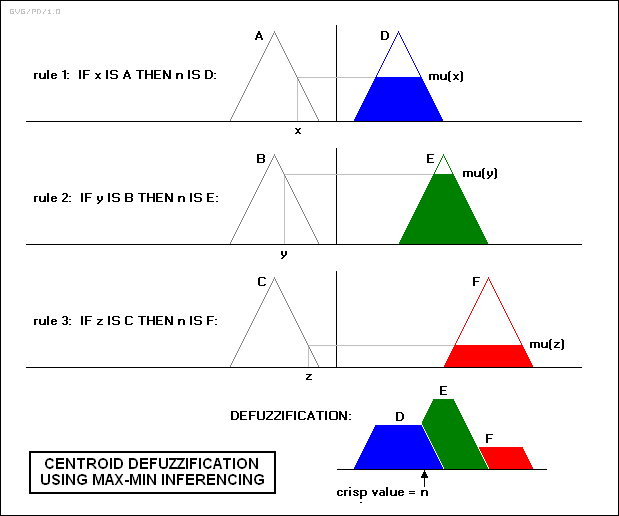
There are several different ways to define the result of a rule, but one of the most common and simplest is the "max-min" inference method, in which the output membership function is given the truth value generated by the premise.

Rules can be solved in parallel in hardware, or sequentially in software. The results of all the rules that have fired are "defuzzified" to a crisp value by one of of several methods. There are dozens in theory, each with various advantages and drawbacks.

The "centroid" method is very popular, in which the "center of mass" of the result provides the crisp value. Another approach is the "height" method, which takes the value of the biggest contributor. The centroid method favors the rule with the output of greatest area, while the height method obviously favors the rule with the greatest output value.

The example below demonstrates max-min inferencing and centroid defuzzification for a system with input variables "x", "y", and "z" and an output variable "n". Note that "mu" is standard fuzzy-logic nomenclature for "truth value":


ادامه نوشته

[1] INTRODUCTION TO FUZZY LOGIC & FUZZY CONTROL

 INTRODUCTION TO FUZZY LOGIC & FUZZY CONTROL

* "Fuzzy logic" has become a common buzzword in machine control. However, the term itself inspires a certain skepticism, sounding equivalent to "half-baked logic" or "bogus logic". Some other nomenclature might have been preferable, but it's too late now, and fuzzy logic is actually very straightforward. Fuzzy logic is a way of interfacing inherently analog processes, that move through a continuous range of values, to a digital computer, that likes to see things as well-defined discrete numeric values.

For example, consider an antilock braking system, directed by a microcontroller chip. The microcontroller has to make decisions based on brake temperature, speed, and other variables in the system.

The variable "temperature" in this system can be divided into a range of "states", such as: "cold", "cool", "moderate", "warm", "hot", "very hot". Defining the bounds of these states is a bit tricky. An arbitrary threshold might be set to divide "warm" from "hot", but this would result in a discontinuous change when the input value passed over that threshold.

The way around this is to make the states "fuzzy", that is, allow them to change gradually from one state to the next. You could define the input temperature states using "membership functions" such as the following:
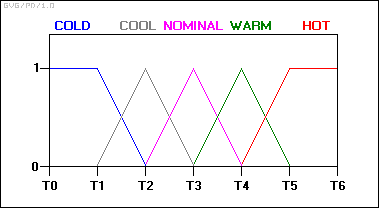
With this scheme, the input variable's state no longer jumps abruptly from one state to the next. Instead, as the temperature changes, it loses value in one membership function while gaining value in the next. At any one time, the "truth value" of the brake temperature will almost always be in some degree part of two membership functions: 0.6 nominal and 0.4 warm, or 0.7 nominal and 0.3 cool, and so on.

The input variables in a fuzzy control system are in general mapped into by sets of membership functions similar to this, known as "fuzzy sets". The process of converting a crisp input value to a fuzzy value is called "fuzzification".

A control system may also have various types of switch, or "ON-OFF", inputs along with its analog inputs, and such switch inputs of course will always have a truth value equal to either 1 or 0, but the scheme can deal with them as simplified fuzzy functions that are either one value or another.

Given "mappings" of input variables into membership functions and truth values, the microcontroller then makes decisions for what action to take based on a set of "rules", each of the form:

   IF brake temperature IS warm AND speed IS not very fast 
   THEN brake pressure IS slightly decreased.

In this example, the two input variables are "brake temperature" and "speed" that have values defined as fuzzy sets. The output variable, "brake pressure", is also defined by a fuzzy set that can have values like "static", "slightly increased", "slightly decreased", and so on.

This rule by itself is very puzzling since it looks like it could be used without bothering with fuzzy logic, but remember the decision is based on a set of rules:

  • All the rules that apply are invoked, using the membership functions and truth values obtained from the inputs, to determine the result of the rule.

  • This result in turn will be mapped into a membership function and truth value controlling the output variable.

  • These results are combined to give a specific ("crisp") answer, the actual brake pressure, a procedure known as "defuzzification".

This combination of fuzzy operations and rule-based "inference" describes a "fuzzy expert system".

Traditional control systems are based on mathematical models in which the the control system is described using one or more differential equations that define the system response to its inputs. Such systems are often implemented as "proportional-integral-derivative (PID)" controllers. They are the products of decades of development and theoretical analysis, and are highly effective.

If PID and other traditional control systems are so well-developed, why bother with fuzzy control? It has some advantages. In many cases, the mathematical model of the control process may not exist, or may be too "expensive" in terms of computer processing power and memory, and a system based on empirical rules may be more effective.

Furthermore, fuzzy logic is well suited to low-cost implementations based on cheap sensors, low-resolution analog-to-digital converters, and 4-bit or 8-bit one-chip microcontroller chips. Such systems can be easily upgraded by adding new rules to improve performance or add new features. In many cases, fuzzy control can be used to improve existing traditional controller systems by adding an extra layer of intelligence to the current control method.


(Electric Machinery Fundamentals (Fourth Edition

)


Stephen J. Chapman, "Electric Machinery Fundamentals (Fourth Edition)"
McGraw Hill Higher Education | ISBN: 0071151559 | 2004-05-01 | 746 pages | PDF | 22.4 MB

Sets an Excellent Standard
I have three standard ****books on electric machines, and the best one by far is Stephen Chapman's Electric Machinery Fundamentals (fourth edition). Chapman has the rare ability to strike a golden balance between theory and practice, and between rigour and informality, such that the theoretical actually illuminates the practical. His discussion on power transformers is the best I have seen anywhere, and he maintains that same high quality throughout the book. Along the way, he has even managed to correct a subtle misconception that I had held for several years concerning Lenz's law. The print quality is superb and the diagrams are sharp and clear. I would like to answer a comment that another reviewer had against this book, namely, that this book uses log or semilog scales. I think we should be grateful that Mr. Chapman had the good judgment to use log or semilog scales, or else we are going to have a book that is hundreds of miles long and wide
دانلود در ادامه مطلب
ادامه نوشته

Reference Data For Engineers


                                              دانلود

                            پسورد:www.iiets.blogfa.com

میکروپروسسور


                                               دانلود

                               پسورد:www.iiets.blogfa.com

منابع تغذیه

e-book منابع تغذیه


                                                  دانلود

                                  پسورد:www.iiets.blogfa.com

Power Electronics Handbook, Second Edition: Devices, Circuits and Applications


Muhammad H. Rashid “Power Electronics Handbook, Second Edition: Devices, Circuits and Applications"
Academic Press | 2006-11-08 | ISBN: 0120884798 | 1192 pages | PDF | 48,3 MB


Power electronics, which is a rapidly growing area in terms of research and applications, uses modern electronics technology to convert electric power from one form to another, such as ac-dc, dc-dc, dc-ac, and ac-ac with a variable output magnitude and frequency. Power electronics has many applications in our every day life such as air-conditioners, electric cars, sub-way trains, motor drives, renewable energy sources and power supplies for computers. This book covers all aspects of switching devices, converter circuit topologies, control techniques, analytical methods and some examples of their applications.
* 25% new content
* Reorganized and revised into 8 sections comprising 43 chapters
* Coverage of numerous applications, including uninterruptable power supplies and automotive electrical systems
* New content in power generation and distribution, including solar power, fuel cells, wind turbines, and flexible transmission


طراحی منابع تغذیه سوئیچینگ عملی

e-book طراحی منابع تغذیه سوئیچینگ عملی


                                                    دانلود

                                      پسورد:www.iiets.blogfa.com

زبان برنامه نویسی c

e-book زیان برنامه نویسی c


                                               دانلود     

                               پسورد:www.iiets.blogfa.com  


طراحی فیلترهای دیجیتال و آنالوگ

e-book طراحی فیلترهای دیجیتال و آنالوگ


                                                دانلود 

                              پسورد:www.iiets.blogfa.com

زبان ++C

e-book ربان ++C


                                               دانلود

                                 پسورد:www.iiets.blogfa.com

رگولاتورهای خطی و سوئیچینگ ولتاژ

 e-book رگولاتورهای خطی و سوئیچینگ ولتاژ


                                               دانلود

                               پسورد:www.iiets.blogfa.com

Universal Translator(مترجم جهانی)


این مترجم فوق العاده پیشرفته وقوی هستش ودر کمتر جایی متونید پیداش کنید


ومن این برنامه رو به تمام دانشجوها پیشنهاد می کنم.

این مترجم قابلیت:

تلفظ کلیه جملات یا عبارات

امکان پرینت متن ها و ترجمه های زبان های مختلف

امکان استفاده از متن های اسکن شده

دارای ویرایشگر قوی جهت کپی و چسباندن متن در ویندوز

قابلیت باز کردن متن های اینترنت

و همچنین ترجمه لغات و عبارات و جملات به 34 زبان بین المللی به یکدیگر از جمله فارسی را دارد

دانلود سی دی :

قسمت اول

قسمت دوم

قسمت سوم

قسمت چهارم

قسمت پنجم

قسمت ششم

قسمت هفتم

قسمت هشتم

قسمت نهم

قسمت دهم

قسمت یازدهم

قسمت دوازدهم

قسمت سیزدهم

پسورد:
vip.pcseven@pcseven

واحد های انتخابی


دانلود عکس بالا

هزینه نهایی این ۱۸ واحد برابر ۳۵۲۸۱۴۰ریال می باشد

موفق باشید

واحد های ترم دوم سال 87-88

آخرین لیست واحدها با ویرایش جدید

دوستان گروه b در ترم اول در صورت تمایل این واحد ها با این گروه ها رو انتخاب کنند

شنبه : ساعت 9 - 11 نقشه کشی و نقشه خوانی گروه 2

شنبه : ساعت  11 - 13 کاربرد رایانه گروه 2

یک شنبه : ساعت 13 - 16 تاسیسات الکتریکی گروه 2

یک شنبه : ساعت 16 - 19 ماشین های الکتریکی گروه 2

چهار شنبه: ساعت ۱۸ - ۲۰ کارگاه تخصصی تابلو گروه ۵

چهار شنبه : ساعت 13 - 16 بررسی سیستم های قدرت گروه ۲

چهار شنبه : ساعت 16 - 18 مدارهای جریان متناوب گروه ۲

در صورت تمایل پنج شنبه :ساعت 14 - 16 مقررات نگهداری

درصورت تمایل به انتخاب این واحدها موافقت خود را اعلام و به بقیه دوستان اعلام بدارید.

موفق باشید.

ثبت‌نام پذيرفته‌شدگان نهايي رشته‌هاي نيمه‌ متمركز آموزشكده‌هاي فني وحرفه‌اي 26 بهمن آغاز مي‌شود

ثبت‌نام پذيرفته‌شدگان نهايي رشته‌هاي نيمه‌ متمركز آموزشكده‌هاي فني وحرفه‌اي 26 بهمن آغاز مي‌شود.

به گزارش سرويس صنفي آموزشي خبرگزاري دانشجويان ايران(ايسنا)، كليه پذيرفته‌شدگان نهايي رشته‌هاي نيمه‌متمركز هنرهاي تجسمي(نقاشي)، گرافيك و تربيت بدني آزمون‌ ورودي دوره‌هاي‌ كارداني‌ نظام جديد آموزشكده‌هاي فني و حرفه‌اي سال 87 ‌بايد با رعايت موارد لازم در يكي از روزهاي شنبه 26 بهمن و يا يكشنبه 27 بهمن با در دست داشتن مدارك لازم براي ثبت‌نام به آموزشكده محل قبولي خود مراجعه كنند.

كليه پذيرفته‌شدگان دانشكده تربيت دبير فني دختران دكتر شريعتي تهران ‌بايد منحصرا 27 بهمن براي ثبت‌نام مراجعه كنند.

كليه پذيرفته شدگان بايد در تاريخ تعيين شده براي ثبت‌نام مراجعه كنند، بديهي است عدم مراجعه در تاريخ مقرر براي ثبت‌نام، به منزله انصراف از تحصيل تلقي خواهد شد.

كليه پذيرفته‌شدگان به شرطي مجاز به ثبت‌نام در آموزشكده‌ محل قبولي خود خواهند بود كه 96 واحد درسي دوره سه ساله در رشته مربوط را تا 30 بهمن با موفقيت طي كرده باشند.

گفتني است، ديپلمه‌هاي ‌نظام ‌قديم ‌بايد كليه دروس دوره چهار ساله خود را به انضمام كارورزي تا تاريخ مقرر گذرانده باشند.

رباتیک: طراحی ماشین آلات خودکار


ebook طراحی ماشین آلات خودکار

دانلود

پسورد:www.iiets.blogfa.com

تحلیل مدارات الکترونیکی گری


 e book تحلیل مدارات الکترونیکی گری

                          دانلود                         

پسورد:www.iiets.blogfa.com

دانلود مجموعه کتابهای زبان


VOCABULARY

PDF دانلود
COMPLETED TEACHING PDF دانلود
GRAMMAR PDF دانلود
WRITING PDF دانلود
رمان PDF دانلود


نظر فراموش نشه.........


سوالات تخصصی کنکور مکانیک۸۷

دفترچه سوالات تخصصی کنکور سراسری کارشناسی ناپیوسته رشته ی مکانیک۸۷


دانلود

 پسورد:www.iiets.blogfa.com

نظر فراموش نشه!!!!!!!!!!!!!!!!!!!!!!!!!!!!!!!

دانلود کتاب الکترونیکی آموزش اینترنت و مبانی اینترنت

اینترنت از مجموعه ای  شبكه  كامپیوتری  بزرگ ، كوچك تشكیل شده  است . شبكه های فوق با روش های متفاوتی بیكدیگر متصل و موجودیت واحدی با نام "اینترنت " را بوجود آورده اند. نام در نظر گرفته شده برای شبكه فوق از تركیب واژه های " Inter connected " و " Net work " انتخاب شده است . 

اینترنت فعالیت اولیه خود را از سال 1969 و با چهار دستگاه كامپیوتر میزبان ( host ) آغاز و پس از رشد باورنكردنی خود ، تعداد كامپیوترهای میزبان در شبكه به بیش از ده ها میلیون دستگاه رسیده است .

 اینترنت به هیچ سازمان و یا موسسه خاصی در جهان تعلق ندارد. عدم تعلق اینترنت به یك سازمان ویا موسسه بمنزله عدم وجود سازمانها و انجمن های مربوطه برای استانداردسازی نیست .یكی از این نوع انجمن ها، "انجمن اینترنت " است كه در سال 1992 با هدف تبین سیاست ها و پروتكل های مورد نظر جهت اتصال به شبكه تاسیس شده است


آموزش اینترنت


حجم : ۳۵۰ کیلو بایت

لینک : دانلود آموزش اینترنت

حجم : ۲۲۰ کیلو بایت

لینک : دانلود آموزش مبانی اینترنت

کتاب درسی مدارهای منطقی موریس مانو

برای مشاهده فایل های با فرمت DJVU از برنامه زیر می توانند استفاده کنند:

دانلود

حجم : 508 KB


بخش اول  

بخش دوم 

  بخش سوم 

    بخش چهارم 

 بخش پنجم

Michael R. Hatch, «Vibration Simulation Using MATLAB and ANSYS»

Michael R. Hatch, «Vibration Simulation Using MATLAB and ANSYS»


Michael R. Hatch, «Vibration Simulation Using MATLAB and ANSYS»
ISBN: 1584882050 | Publisher: Chapman & Hall/CRC | Publication Date: 2000-09-21 | Number Of Pages: 680 | pdf | 7,7 mb


Book Description

Incorporating the use of MATLAB to help with the solution of problems, this text explores the subject of vibration from a fairly sophisticated, mathematical point of view. With a three degree-of-freedom (DOF) system as a unifying theme, the author develops the associated equations of motion, then in each chapter includes both a closed-form solution and the MATLAB code for solving a problem. The book's unique approach makes it especially useful for engineers who lack experience with state space, and it will prove useful to both the mechanical and control engineering communities in enhancing their ability to communicate.

مجلات منتشر شده در June 2008

ادامه نوشته

simulink

قسمت اول آموزش simulink:


Simulink یکی از ابزارهای مهم در MATLAB به شمار می رود .در این ابزار که یک کتابخانه عظیم است شما به راحتی می توانید تحلیل های واقعی خود را در محیطی مجازی با تنظیم اندازه دقیق پارامتر ها به دست آورید این کتابخانه ها آنقدر عظیم و بزرگ هستند که در اکثر گرایش های مهندسی اعم از برق ،کامپیوتر،مکانیک و ... کاربرد بسزایی دارند.


در زیر با یک مثال ساده که از کتاب راهنمای کاربردی SIMULINK نوشته مهندس جمشیدی است کار را شروع می کنیم:


ایجاد یک موج سینوسی:


نموداری از انتگرال و مشتق یک موج سینوسی را به همراه نمودار موج سینوسی برحسب زمان ترسیم کنید:


در ابتدا با تایپ کردن کلمه simulink در خط فرمان و یا کلیک بر روی آیکون سیمولینک در toolbar ، آن را باز کنید حال بلوک های فوق را که در زیر هم نوشته شده اند را در یک مدل جدید که از گزینه file ،  new model قابل دسترسی است وارد نمایید:


Simulink>>sources>>sine wawe

Simulink>>continuous>>Derivative

Simulink>>continuous>>Integrator

Simulink>>Commonly Used Blocks>>Mux

Simulink>> Commonly Used Blocks>>Scope


و آنها را مانند شکل فوق به راحتی به یکدیگر متصل نمایید.


روی بلوک mux  دو بار کلیک کنید و در پنجره Number of inputs عدد سه را وارد کرده و ok کنید و با این کار تعداد ورودی های بلوک را به سه می رسانیم.


اجرای مدل:


زمان اجرای مدل را همانند شکل زیر روی 15 کنید.


و سپس آن را اجرا کنید برای دیدن خروجی روی بلوک اسکوپ دو بار کلیک کنید و روی علامت دوربین کلیک کنید تا شکل خروجی را بهتر ملاحظه کنید.


کتاب درسی سیگنالها و سیستمهای اوپن هایم

 کتاب درسی سیگنالها و سیستمهای اوپن هایم 

بخش اول 

بخش دوم 

  بخش سوم 

   بخش چهارم 

 بخش پنجم 

   بخش ششم